FNLA–UNITA coalition
Another Day of LifeThe FNLA–UNITA coalition joined two movements in a military and political effort to displace the MPLA and claim national authority at the end of Portuguese rule. The coalition’s projected government was built into the planning for Operation Orange: its forces were to occupy Luanda before the Portuguese withdrawal, and power was then supposed to pass to an FNLA–UNITA government. The book follows that intended transfer from operational plan to unrealized outcome, ending with a report of a rival government and a country divided between competing political centers.
Political purpose and timetable
The coalition’s intended role was explicit in the timetable for Operation Orange. The stated objective was to occupy Luanda by 6 p.m. on 10 November 1975, when, under the Alvor Agreement, the last Portuguese units were due to leave Angola. On the following day, independence was to be announced with power passing to an FNLA–UNITA coalition government. The plan therefore tied military possession of the capital to the political succession: the coalition was not merely a supporting force but the proposed recipient of state power.
This schedule also made Luanda the decisive prize. Taking the city before the Portuguese departure would allow the coalition to present itself as the government at the moment of independence. The plan depended on a rapid advance and on the expectation that the MPLA would not be able to resist effectively. As the account later makes clear, that expectation did not match the unfolding war: the intended occupation did not happen, and the rival political settlement emerged elsewhere.
Military coordination
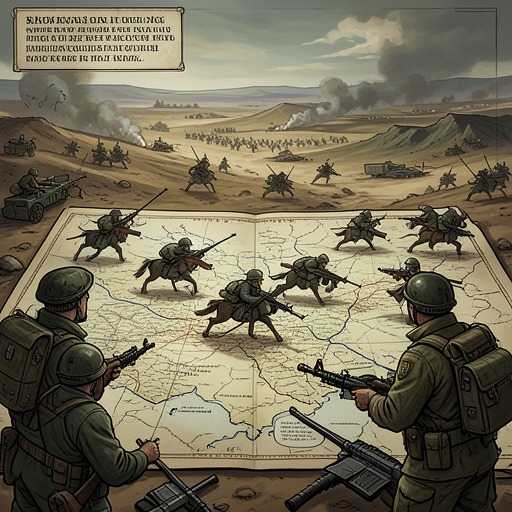
Operation Orange envisioned simultaneous advances toward Luanda from three directions. The southern route ran from Tsumeb through Pereira d’Eça, Lubango, Benguela, and Novo Redondo. The northern route ran through Maquela do Zombo, Carmona, and Caxito. A third advance was planned from the east through Nova Lisboa, Quibala, and Dondo. Rather than describing a single coalition army moving as one body, the plan assigned different partners and support forces to separate fronts.
On the southern flank, South African army motorized units were to receive support from Portuguese volunteers, FNLA and UNITA units, and the Chipenda force. On the northern flank, FNLA units were to advance with units of Zaïre’s army and Portuguese volunteers. The eastern flank was assigned the same combination as the northern one. This arrangement placed the FNLA on two approaches and included UNITA among the southern supporting forces, while South African and Zaïrean military participation supplied the wider regional backing for the operation.
The coalition’s projected advance was thus part of a larger intervention, not an isolated contest between Angolan movements. The planned routes converged on Luanda, while the supporting forces varied by direction. That design linked the coalition’s claim to power with foreign military assistance and a timetable calibrated to the Portuguese departure. In the account, however, the plan’s precision stands in contrast to the unsettled reports and changing control on the ground.
Conflict, claims, and setbacks
The coalition appears in the book both as a force approaching the capital and as the subject of competing wartime accounts. In September, leaflets dropped over Luanda announced that Holden Roberto’s army was outside the city and would enter soon. They urged the population to target Eastern European commanders serving with the MPLA, presenting them as responsible for the war and the country’s misfortunes. The narrator notes that he was then the only person from Eastern Europe in Angola. The leaflets made the approaching force’s claims part of the city’s climate of fear, where rumor and political messaging were difficult to separate from immediate danger.
The fighting did not consistently favor the coalition’s side. During the battle for Caxito, Comandante Ndozi’s unit seized the town from the FNLA and took 120 prisoners. This local reversal sits beside the larger strategic picture later described by the narrator: half the country was in enemy hands, yet the MPLA’s radio communiqués could still sound close to victory. The coalition and its allies therefore occupy a changing battlefield rather than a narrative of uninterrupted advance. Reports of territorial control, official optimism, and observed setbacks coexist without resolving neatly into a single account of momentum.
A further measure of the coalition’s advance appears in a dispatch reporting that the South African army, supported by mercenaries and FNLA and UNITA units, had occupied Benguela. The report identifies the coalition’s partners in an actual territorial gain, but it does not establish that this advance achieved the planned capture of Luanda. The distinction matters: occupying an important city on the southern route was not the same as securing the capital or obtaining the government envisaged in the Operation Orange timetable.
Rival government and political partition
After the proclamation of the People’s Republic of Angola in Luanda, a radio station outside Angola reported that the FNLA and UNITA had decided to form their own government, with Huambo as its capital. The report immediately qualified that arrangement: Huambo would be a capital in name, since the organizations’ actual headquarters were in Kinshasa. The coalition’s political project thus persisted after it failed to take Luanda, but its proposed center of authority lay outside the capital and depended on a divided territorial and institutional reality.
The book describes the immediate result as Angola being divided, for the moment, into two states with exceptionally complicated borders. That formulation presents the coalition government not as a completed national settlement, but as one side of a precarious partition. Its relationship with the MPLA is therefore defined by both military rivalry and competing claims to govern independent Angola. The distance between the planned transfer of power in Luanda and the reported government in Huambo, headquartered in Kinshasa, gives the coalition’s story its decisive shape: an intended national succession became a rival authority amid continued war and political division.